Every city guide for WorldPride Amsterdam will tell you three things: go to Reguliersdwarsstraat, watch the Canal Parade, and book early. That's fine. That's the brochure version.
This is the version your queer friend who lived there for a year would give you over drinks. The neighbourhood breakdown. The bar your straight friends would never find. The part of the city where you stop performing and start belonging.
Amsterdam is hosting WorldPride from July 25 to August 8, 2026, the first time the Netherlands has held it. If you're going alone, this is your map. If you're still deciding whether to go at all, read why going to Pride alone is worth it first, then come back here.
The Lay of the Land
Amsterdam's queer geography isn't one street. It's five or six micro-neighbourhoods, each with a completely different energy, scattered across a city small enough to walk end-to-end in 45 minutes. Knowing which one matches you is the difference between a good trip and the trip you'll talk about for years.
Here's the honest version of each one.
 AmsterdamNetherlandsWorldPride ready
Reguliersdwarsstraat, The Main Strip
This is the one everyone knows. A 200-metre stretch between Rembrandtplein and Muntplein, packed with fifteen-plus LGBTQ+ venues. Rainbow crossing on the pavement. You can walk it end to end in under three minutes.

What it's actually like: High energy, international crowd, drinks-forward. The terraces spill onto the street in summer and the whole strip operates as one continuous party from about 9pm onwards. It's fun, it's loud, and during WorldPride it will be absolutely rammed.
Where to go: Cafe Montmartre for early evening cocktails, it was voted the most popular gay bar in the Netherlands. Soho if you want a strictly gay crowd. Exit Cafe is tiny and chaotic and everyone ends up singing karaoke in the back room. Club NYX has three floors and stays open until 5am, it's the end-of-the-night spot.
Who it's for: If you want the classic big-night-out gay bar experience, this is it. It trends younger and more male, but it's genuinely welcoming across the spectrum.
The honest bit: It can feel overwhelming solo, especially on a Friday or Saturday at peak hours. The trick is to go early, 5 to 7pm happy hours are quieter, the regulars are friendlier, and you can settle in before the street fills up.
Zeedijk, The One with History
A five-minute walk north of Reguliersdwarsstraat, on the edge of the Red Light District. This is where Amsterdam's queer history actually lives.
What it’s actually like: Older, quieter, more local. This is the neighbourhood where queer Amsterdam existed before Reguliersdwarsstraat became the main strip. The energy is more brown-cafe-and-conversation than dance-floor-and-shots.
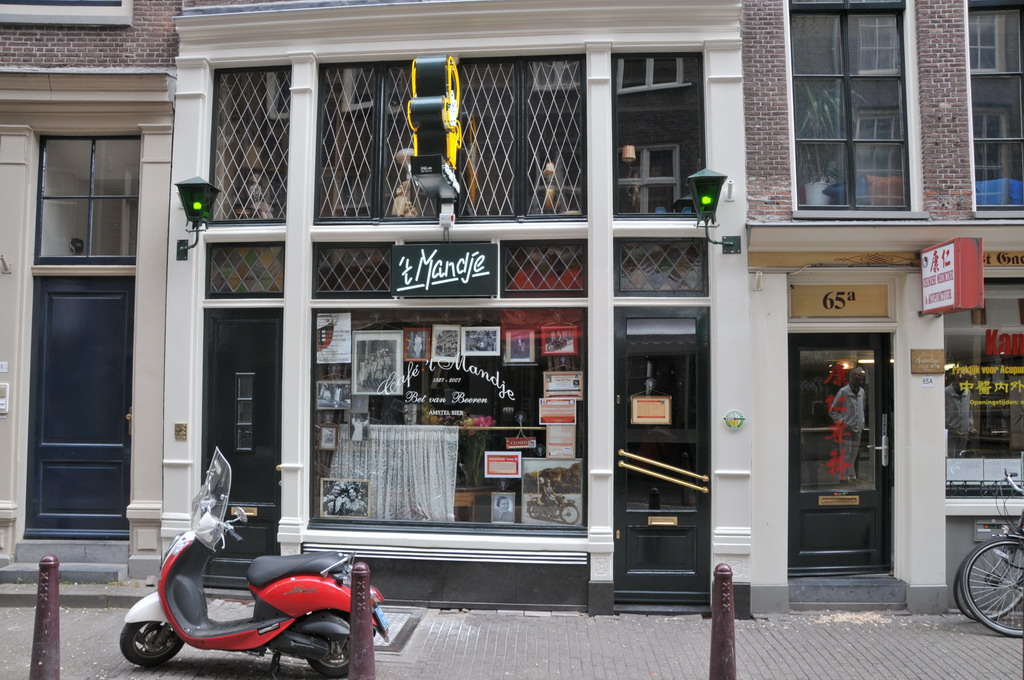
Where to go: Cafe 't Mandje. Full stop. Opened in 1927 by Bet van Beeren, a legendary lesbian bar owner, it's one of the most important surviving LGBTQ+ bars in Europe. It's tiny, maybe 30 people fit, and covered floor to ceiling in leather memorabilia, biker jackets, and photos from a century of queer life. It's open Thursday to Sunday and you should go at least once. The Queen's Head nearby has canal views, drag bingo, and one of the warmest atmospheres in the city.
Who it's for: Anyone who wants to feel the weight of queer history in a place that isn't a museum. Also: anyone who finds Reguliersdwarsstraat too intense and wants something cosier.
Solo traveler note: The Queen's Head on a Thursday evening is one of the easiest places in Amsterdam to start a conversation with a stranger. The drag bingo helps.

Kerkstraat, The Village Within the Village
Running parallel to the main canal ring, Kerkstraat is Amsterdam's original queer neighbourhood, before Reguliersdwarsstraat took the spotlight. It has a quieter, more residential feel with a distinct village energy.
What it's actually like: Relaxed, slightly older crowd, less performance. The kind of place where regulars nod at each other because they've been coming for years. De Spijker has been here since 1978 and still draws an older, more laid-back crowd. Club Church hosts large-scale themed nights throughout the week for the fetish community, it's not casual, but it's respected and welcoming to anyone who shows up with genuine curiosity.
Who it's for: If you're over 30 and the idea of shouting over music at 1am makes you tired, this is your neighbourhood. Also: anyone interested in the leather and fetish scene, Kerkstraat connects naturally to the Warmoesstraat corridor.
Van Lennepbuurt (Oud-West), The New Wave
This is the one the travel guides haven't caught up with yet. West of the canal ring in Oud-West, Van Lennepbuurt has emerged as Amsterdam's newest queer neighbourhood, more alternative, more diverse, more women and non-binary people.
What it’s actually like: Cut by canals, lined with terraces and sunspots, and buzzing with a crowd that skews younger, queerer, and less interested in the traditional gay bar format. This is where queer Amsterdam is heading, not where it’s been.
Where to go: PAMELA for small plates and cocktails, the crowd is buzzy and diverse. Bar Bario around the corner brings Latin energy and excellent mojitos. And on Sunday nights, De Trut is unmissable. It's a queer-run volunteer disco that's been going since the 1980s, opens at 10pm, cash only at the door, and no phones allowed inside. The line starts forming at 9pm in summer. It's one of the most genuinely safe queer spaces in the city.
Who it’s for: Queer women, non-binary people, anyone who doesn’t see themselves in the Reguliersdwarsstraat scene. If you’re a queer woman who’s felt invisible in “gay” travel guides that mostly mean gay men, start here.
Solo traveler note: De Trut's no-phones policy sounds intimidating alone, but it's actually a gift. Everyone talks to each other because nobody's looking at a screen.

Warmoesstraat, The Leather District
On the edge of the Red Light District, a five-minute walk from Central Station. This is Amsterdam's leather and fetish corridor.
What it's actually like: Dark, direct, no-nonsense. The Eagle has been here since 1984. Dirty Dick's lives up to its name. These venues have dress codes and darkrooms and monthly events that are exactly what they sound like. They're not for everyone, and they don't pretend to be.
Who it's for: If you know, you know. If you're curious, the leather scene is welcoming to visitors who respect the codes. Best visited before midnight, after that, the surrounding Red Light District gets significantly more crowded and chaotic. The safety concern in this area isn't anti-queer hostility; it's standard tourist-area pickpocketing.
De Pijp, Where Queer People Actually Live
South of the canal ring, De Pijp is a residential neighbourhood with a younger queer population, excellent food, and zero rainbow flags.
What it's actually like: Less scene, more life. This is where queer Amsterdammers go to the market on Saturday morning, eat Ethiopian food on Albert Cuypstraat, and drink coffee at a cafe where nobody's performing anything. There are no dedicated LGBTQ+ venues here, the whole neighbourhood is queer-friendly in the way that only happens when queer people have lived somewhere long enough to stop needing a dedicated space.
Who it’s for: Anyone staying more than three days. If you want to feel like you live in Amsterdam rather than visit it, base yourself here. The Albert Cuyp market is one of the best street markets in Europe and the food stalls alone are worth the trip.

WorldPride Amsterdam 2026 Practical Plan
Where to stay for WorldPride: If you want to be in the middle of everything, stay near Rembrandtplein (walking distance to Reguliersdwarsstraat, Zeedijk, and the canal parade route). If you want a quieter base, De Pijp or Oud-West are 15 minutes by tram and half the price. Book now, WorldPride accommodation has been selling out months in advance.
Getting around: Bike or tram. Rent a bike from a local shop, not from the tourist stands at Central Station. An OV-chipkaart (transit card) costs EUR 7.50 and works on trams, buses, and metro. Trams run until about 12:30am; night buses cover the main routes after that. A taxi from Reguliersdwarsstraat to most neighbourhoods is EUR 10-20, use the Uber app or the TCA taxi app, not street cabs.

The beach option: Zandvoort is 30 minutes by train and has designated LGBTQ+ beach sections. Bloemendaal aan Zee is the trendier alternative with DJ beach bars. Both are popular summer escapes for queer Amsterdam and will be packed during WorldPride.
Safety: Amsterdam is one of the safest cities in Europe for queer travelers. PDA is completely normal everywhere in the city centre. The main safety note is pickpocketing in crowded tourist areas, Reguliersdwarsstraat and the Red Light District during peak hours especially. Keep your phone in a front pocket or crossbody bag. Trans and non-binary travelers should also read the Pride safety guide for trans travelers before booking. For broader travel prep, our packing and planning guide covers the rest.
For more on what "queer-friendly" actually looks like in practice, see our guide to reading the real signals.
The One Thing the Brochure Won't Tell You
Amsterdam's queer culture isn't concentrated, it's everywhere. The Netherlands legalised same-sex marriage 25 years ago, and a quarter century of legal normalcy has produced something you can feel walking down any street in the city. There's no need for a gay quarter when the whole city is one.
That's what makes WorldPride here different from WorldPride anywhere else. You're not visiting a queer event in a straight city. You're visiting a city that stopped making the distinction a generation ago.
Go alone. Walk the canal ring at midnight. Let a stranger at 't Mandje tell you about the woman who opened that bar in 1927. Sit on a terrace in De Pijp and watch the neighbourhood happen around you.
The city doesn't need you to perform anything. Just show up.
Check current Amsterdam and WorldPride information
- WorldPride Amsterdam 2026
Official programme, event, route, access, and visitor updates.
- I amsterdam LGBTQI+ safety resources
Local safety, discrimination reporting, health, and support information.